Granny's Tales and Treasures
Our Buckinghamshire Ancestry
William and Ann Howe and their Children
The story of earlier generations of the Howe family can be found here. The focus is now on great great grandfather William, the eldest son of Robert and Charlotte Howe née Chilton, who was born on the 9th of March 1831 and was baptised in Great Kimble on the 10th of April 1831.[i] The censuses show that William’s younger brothers and therefore presumably William himself, were working on the land from a very young age.[ii] This would have been a necessary contribution to the family income and illustrates the importance of children’s earnings to the family economy. Thirty nine percent of the 133 five to fourteen year olds in Great Kimble in 1851 were working. In addition there were eleven boys described as ‘farmer’s son’ who would almost certainly have been helping their fathers.[iii]
The 1841 census found William Howe living with his parents in Great Kimble, when the head of the household was Philip Chilton, William’s maternal grandfather. At seventy years of age, Philip was still working as an agricultural labourer,[iv] reflecting the necessity to continue in employment in a time before old age pensions.
As a young teenager, William took employment as an agricultural labourer, working on local farms. At the time of the 1851 census he was a live-in farm servant on the eighty eight acre Meadle Farm of John Langston, in neighbouring Monks Risborough, Buckinghamshire.[v]
Despite the Swing Riots and an increased demand for labourers following waves of emigration, wages for agricultural labourers were still low in Buckinghamshire in the 1850s. Perhaps attracted by the promise of up to £6 bounty, in 1852, William Howe responded to a recruiting poster and enlisted in the Royal Bucks King’s Own regiment of militia.[vi] The militia were groups of amateur soldiers, mustered in times of strife or perceived threat. The Militia Act of 1852 was a response to the fear of a French invasion and 80,000 men were sought. It was hoped to recruit sufficient volunteers but the Act did provide for a ballot to force men to enrol should they not come forward. Private 492 William How [sic] was recruited on the 28th of October 1852, at the age of twenty years and eight months. His height was 5’ 6¼”, his occupation was listed as labourer and he received an initial bounty of sixteen shillings. Over the next two years, William undertook several periods of service throughout the county, receiving regular bounty payments of up to £3 13/- a quarter.[vii] This illustrates how wider-reaching foreign affairs affected the life of a simple agricultural family in the provinces.
By 1854, William was in a relationship with Ann Stratford from Aston Clinton. William and Ann’s eldest child, Mary Ann, was born in Aston Clinton on the 13th of March 1855, three months before they married.[viii] At her baptism, which took place in Great Kimble after the marriage, her parents were listed as Robert and Charlotte.[ix] As Charlotte would have been fifty at the time, this seems unlikely, also, Mary appears in the 1861 census as William’s daughter.[x] Mary Ann’s birth was registered as Mary Ann Howe Stratford, with her mother named as Ann Stratford,[xi] underlining that she was the child of William and Ann and demonstrating that the baptism record was misleading. From this single instance, it is difficult to draw any conclusions about pre-marital pregnancy however, in this respect, Ann was adding weight to those who reviled the straw plaiting women as being promiscuous. In his book about straw plaiting, Children of Straw, Lazlo Grof mentions an unreferenced Parliamentary Report of 1842, which stated that, “the moral condition of the lace-makers seems nearly as low as that of the plaiters… chastity is at a sad discount … prostitution is at a high premium.”[xii]
William and Ann went on to have five more daughters and three sons, all of whom survived to adulthood and married, which seems unusual in times of poverty and poor public health.[xiii] It is possible that there were miscarriages but the children are very evenly spaced.

Believed to be the home of William and Ann Howe
© Janet Few
It appears that William and Ann spent thirty years in the same cottage.[xiv] It is likely that they moved there on marriage in 1855 and were still there in 1886, when their daughter, Caroline, returned from Battersea in order to give birth to her daughter, grandmother Elizabeth Ann Hogg.[xv] The census returns of 1861 and 1871[xvi] suggest that this cottage was close to a Chapel and The Crown Inn, with just one cottage between the Howes and the Inn. In twenty-first century Little Kimble, Old Chapel Close indicates the site of the Chapel and on a visit in the early 2000s, an Indian Restaurant inhabited what appeared to be the former Crown Inn. Next door was one cottage, named ‘The Hobbit’, clearly old enough to have been built by the 1850s. Further on again, was Brookside House, where William and Ann’s daughter Jane was working in 1881.[xvii] So where could William and Ann have lived? Had it been demolished? Looking more carefully at ‘The Hobbit’ it becomes clear that this was once two cottages; the brickwork round a second front door is clearly visible to the left of the existing door. So, the right-hand half of ‘The Hobbit’ was almost certainly home to William, Ann and their nine children. In 1861, the family, by then with four children, even found room for a lodger, George Fleet, almost certainly an economic necessity. [xviii]
Toward the end of their lives, William and Ann went to live in Weston Road in Ann’s home parish of Aston Clinton, next to their son Joseph, for a time. They were there in 1891, when, at the age of sixty, William was working as a roadman and by this time, Ann had lost her hearing.[xix] Ten years later, they had returned to Great Kimble and were living in Smokey Row. William was working as a horseman on a farm. Ann had gone back to plaiting straw.[xx] William, described as a farm labourer, died in Great Kimble, of exhaustion and acute bronchitis, on the 14th of December 1904. His death was registered by his daughter-in-law Louisa, who had come down from Fulham and had been in attendance at the time of William’s death.[xxi]
The Children of William and Ann Howe née Stratford
Mary Ann

Ann Howe née Stratford and her daughter Mary Ann Rutland née Howe
William and Ann’s eldest daughter, Mary Ann, was with her parents in Great Kimble in the 1861 census.[xxii] By 1871, she was working as a domestic servant for Thomas Field, a watchmaker, in Bicester Road, Aylesbury.[xxiii] On the 5th of June 1878, Mary Ann married local agricultural labourer, William Rutland, in Great Kimble.[xxiv] In 1861 and 1871, William and his family had been living next door to Mary Ann’s grandparents, Robert and Charlotte Howe.[xxv] William and Mary Ann had just one child, a son, Francis William Rutland, who was born at Great Kimble on the 4th of July 1879.[xxvi]
In 1881, the Rutlands were living at Risborough Road, Great Kimble, close to the vicarage, in what appears to be the cottage previously occupied by William’s parents. Mary Ann was listed as a straw plaiter.[xxvii] Ten years later, the family were still in Great Kimble, at Church Cottages, School Lane, next door to William’s parents. William and his eleven year old son, Francis, were agricultural labourers and Mary Ann was still plaiting straw. Living with them was Mary’s newly widowed sister, Grace.[xxviii] William Rutland died in 1906 but Mary Ann remained in Great Kimble until her death in September 1940.[xxix]
Caroline
The second daughter of William and Ann Howe née Stratford was great grandmother Caroline, who was born at Little Kimble on the 10th of February 1857.[xxx] Like her elder sister, Caroline can be found with the family in 1861[xxxi] but by 1871, had left home to go into service. She was working just up the road from Mary Ann, in the household of Mary Perry.[xxxii] Ten years later, Caroline was a housemaid for Aylesbury solicitor, Thomas Howard, his wife and six children and was living at 10 Church Street in the town, along with three other live-in servants.[xxxiii] 10 Church Street is now a grade 2 listed building and is described as being a fifteenth or sixteenth century property with an eighteenth century frontage and nineteenth century roof. All three gable ends were part of the same house, which had two stories and an attic[xxxiv].

10 Church Street, Aylesbury
Image by ‘No Swan so Fine’ via Wikimedia Commons
The following information, about the duties of a housemaid, also appears in other family stories involving housemaids. According to Mrs Beeton, writing in 1861, Caroline was likely to have been earning between £12 and £20 a year. Mrs Beeton gives detailed instructions for housemaids, outlining all their duties.
“Housemaids, in large establishments, have usually one or more assistants; in this case they are upper and under housemaids. Dividing the work between them, the upper housemaid will probably reserve for herself the task of dusting the ornaments and cleaning the furniture of the principal apartments, but it is her duty to see that every department is properly attended to.”[xxxv]
Mrs Beeton goes on to describe the responsibilities of the housemaid, who was expected to begin work at 6am in summer and 6.30am to 7am in winter. In colder months, the first duty was to clean and blacklead the grate and lay and light the fires. Next would be dusting the downstairs rooms and sweeping the carpets, having first sprinkled them with tealeaves. Mrs Beeton is specific about how this should be done,
“It is not enough, however, in cleaning furniture, just to pass lightly over the surface; the rims and legs of tables, and the backs and legs of chairs and sofas, should be rubbed vigorously daily; if there is a book-case, every corner of every pane and ledge requires to be carefully wiped, so that not a speck of dust can be found in the room.”[xxxvi]
In the absence of a lady’s maid in household, Caroline would light the fire in her mistress’ dressing room and air her clothes on the fireguard.
Then it was back to cleaning the downstairs rooms and the staircase.
“She should go into the drawing-room, cover up every article of furniture that is likely to spoil, with large dusting-sheets, and put the chairs together, by turning them seat to seat, and, in fact, make as much room as possible, by placing all the loose furniture in the middle of the room, whilst she sweeps the corners and sides. When this is accomplished, the furniture can then be put back in its place, and the middle of the room swept, sweeping the dirt, as before said, towards the fireplace. The same rules should be observed in cleaning the drawing-room grates as we have just stated, putting down the cloth, before commencing, to prevent the carpet from getting soiled. In the country, a room would not require sweeping thoroughly like this more than twice a week; but the housemaid should go over it every morning with a dust-pan and broom, taking up every crumb and piece she may see.”[xxxvii]
All this took place before the household ate breakfast. Mrs Beeton gives no indication of when the poor housemaid might eat her own meals.
As there was no footman or parlourmaid, Caroline was also responsible for the breakfast table.
“The duty of laying the breakfast-cloth rests on the housemaid. Before laying the cloth for breakfast, the heater of the tea-urn is to be placed in the hottest part of the kitchen fire; or, where the kettle is used, boiled on the kitchen fire, and then removed to the parlour, where it is kept hot. Having washed herself free from the dust arising from the morning's work, the housemaid collects the breakfast-things on her tray, takes the breakfast-cloth from the napkin press, and carries them all on the tray into the parlour; arranges them on the table, placing a sufficiency of knives, forks, and salt-cellars for the family, and takes the tray back to the pantry; gets a supply of milk, cream, and bread; fills the butter-dish, taking care that the salt is plentiful, and soft and dry, and that hot plates and egg-cups are ready where warm meat or eggs are served, and that butter-knife and bread-knife are in their places. And now she should give the signal for breakfast, holding herself ready to fill the urn with hot water, or hand the kettle, and take in the rolls, toast, and other eatables, with which the cook supplies her, when the breakfast-room bell rings; bearing in mind that she is never to enter the parlour with dirty hands or with a dirty apron, and that everything is to be handed on a tray; that she is to hand everything she may be required to supply, on the left hand of the person she is serving, and that all is done quietly and without bustle or hurry. In some families, where there is a large number to attend on, the cook waits at breakfast whilst the housemaid is busy upstairs in the bedrooms, or sweeping, dusting, and putting the drawing-room in order.”[xxxviii]
After breakfast, the housemaid’s attention turned to the upstairs rooms. This involved airing and making the beds. This was not a straightforward activity.
“Before beginning, velvet chairs, or other things injured by dust, should be removed to another room. In bedmaking, the fancy of its occupant should be consulted; some like beds sloping from the top towards the feet, swelling slightly in the middle; others, perfectly flat: a good housemaid will accommodate each bed to the taste of the sleeper, taking care to shake, beat, and turn it well in the process. Some persons prefer sleeping on the mattress; in which case a feather bed is usually beneath, resting on a second mattress, and a straw paillasse at the bottom. In this case, the mattresses should change places daily; the feather bed placed on the mattress shaken, beaten, taken up and opened several times, so as thoroughly to separate the feathers: if too large to be thus handled, the maid should shake and beat one end first, and then the other, smoothing it afterwards equally all over into the required shape, and place the mattress gently over it. Any feathers which escape in this process a tidy servant will put back through the seam of the tick; she will also be careful to sew up any stitch that gives way the moment it is discovered. The bedclothes are laid on, beginning with an under blanket and sheet, which are tucked under the mattress at the bottom. The bolster is then beaten and shaken, and put on, the top of the sheet rolled round it, and the sheet tucked in all round. The pillows and other bedclothes follow, and the counterpane over all, which should fall in graceful folds, and at equal distance from the ground all round. The curtains are drawn to the head and folded neatly across the bed, and the whole finished in a smooth and graceful manner. Where spring-mattresses are used, care should be taken that the top one is turned every day. The housemaid should now take up in a dustpan any pieces that may be on the carpet; she should dust the room, shut the door, and proceed to another room.”[xxxix]
Candlesticks had to be cleaned and lamps trimmed, soft furnishings had to brushed. Finally Mrs Beeton says, “And now the housemaid may dress herself for the day, and prepare for the family dinner, at which she must attend.”[xl] Mrs Beeton provides detailed instructions on how the housemaid should behave during dinner.
“For waiting at table, the housemaid should be neatly and cleanly dressed, and, if possible, her dress made with closed sleeves, the large open ones dipping and falling into everything on the table, and being very much in the way. She should not wear creaking boots, and should move about the room as noiselessly as possible, anticipating people's wants by handing them things without being asked for them, and altogether be as quiet as possible. It will be needless here to repeat what we have already said respecting waiting at table, in the duties of the butler and footman: rules that are good to be observed by them, are equally good for the parlour-maid or housemaid.
The housemaid having announced that dinner is on the table, will hand the soup, fish, meat, or side-dishes to the different members of the family; but in families who do not spend much of the day together, they will probably prefer being alone at dinner and breakfast; the housemaid will be required, after all are helped, if her master does not wish her to stay in the room, to go on with her work of cleaning up in the pantry, and answer the bell when rung. In this case she will place a pile of plates on the table or a dumbwaiter, within reach of her master and mistress, and leave the room.”[xli]
The housemaid was also responsible for clearing the table and washing the plates and cutlery. Caroline may have had to wash the pots and pans if there was no daily servant to do so. She also had to prepare and serve tea. Then there was turning down the beds and lighting the bedroom fires in the evening.
There were other tasks that were not carried out on a daily basis but which nonetheless had to be fitted into the housemaid’s schedule. Polishing brass, brushing the mattresses, polishing the floor and wiping the wainscotting (skirting boards) were weekly tasks. Spring cleaning, which was also advised in autumn, was a mammoth task. As well as a thorough cleaning, involving removing all the furniture from each room in turn and taking carpets up to be beaten, curtains and bedding had to be changed for ones more suitable to the upcoming season. The housemaid was expected to undertake minor repairs to furniture and china and Mrs Beeton helpfully provides a recipe for glue for such occasions, as well as other instructions for various household products.
Even Caroline’s leisure was not her own,
“On leisure days, the housemaid should be able to do some needlework for her mistress,—such as turning and mending sheets and darning the house linen, or assist her in anything she may think fit to give her to do. For this reason it is almost essential that a housemaid, in a small family, should be an expert needlewoman; as, if she be a good manager and an active girl, she will have time on her hands to get through plenty of work.”[xlii]
It seems likely that Caroline then went to work in London as, on the 3rd of August 1885, she married John Hogg at Battersea parish church. Her address was given as 59 York Road, Battersea but no occupation was recorded for Caroline on the marriage certificate. The witnesses were Thomas Robertson, who shared lodgings with John Hogg and James Spice.[xliii] At this time, York Road was an area inhabited by shopkeepers and tradesmen, many of who kept general servants, so it is likely that Caroline had been employed there.[xliv] Sadly, no photograph survives of Caroline but there are images of her mother and four of her sisters. Mary Ann and Emily were quite thin faced and perhaps took after their father, whereas Jane Ann Rose and their mother, Ann, are much fuller faced, as was Caroline’s daughter, so it is likely that Caroline resembles her sisters Jane and Ann Rose. Caroline’s story continues under Hogg.[xlv]
Grace
A third daughter, Grace, was born to William and Ann Howe in Great Kimble in 1859 and appears with the family in Great Kimble in 1861.[xlvi] By 1871, when Grace was only twelve, she was already away from home.[xlvii] At first glance, she cannot be located in the 1871 census[xlviii] but is almost certainly the twelve year old Sarah Howe, working as a servant at Small Dean, Wendover, for farmer Joseph Wooster.[xlix] There are no other records relating to Sarah and households did occasionally change their servants’ names, so that they only had to remember one name because the housemaid was always Sarah; or it could, of course, just be an error.
By 1881, Grace had taken over from her elder sister, Mary Ann, as servant to the watchmaker Thomas Field, who by this time was living at 14 Rickfords Hill, in Aylesbury.[l] In 1888, Grace married John Niblet Meredith, who came from Radnorshire. They married in Wycombe registration district.[li] Two years later, John died in London[lii] and Grace was living with her elder sister, Mary Ann in Great Kimble, working as a dressmaker in 1891.[liii] It was not until 1916 that Grace remarried, in Willesden, Middlesex, to John Charles Cresswell.[liv] Grace Cresswell, of 67 Oaklands Road, Cricklewood died on the 10th of August 1924.[lv]
John ‘Jack’
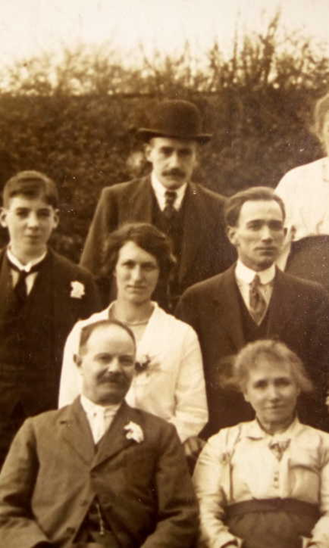
John ‘Jack’ and Sarah Howe née Lovegrove in the front
John, or Jack, was the eldest son of William and Ann Howe née Stratford. He was born early in 1861 in Great Kimble and can be found in the census, aged one month, with his parents at Great Kimble.[lvi] In 1871, when the address was given as Aylesbury Road, Little Kimble, John was described as a scholar.[lvii] Ten years later, John was still at home, at what is apparently the same address, by now working as an agricultural labourer.[lviii] In 1882, John married Sarah Elizabeth Lovegrove from Aston Clinton, who was heavily pregnant.[lix] Sarah, a straw plaiter, had already given birth to an illegitimate daughter, Gertrude, four years earlier, when she was only sixteen.[lx] Gertrude became part of the Howe family and Jack and Sarah had eight children together.[lxi] They began their life in Aston Clinton where Leslie Herbert J was born in 1882, followed by Mildred Grace [Milly] c.1885, Ethel May in 1886 and Frederick William in 1888.[lxii] The family then moved to Battersea where Niblett was born; he took his name from John’s brother in law John Niblett Meredith, to whom Grace Howe was married at the time of his birth.[lxiii] Was this move to Battersea prompted by the fact that Jack’s sister, Caroline, was already living there?[lxiv]
In 1891, John and Sarah were living at 13 Granfield Street in Battersea and John was employed as a general labourer. With them were their five children and Gertrude. Gertrude and the three elder Howe children were listed as scholars in the census.[lxv] Niblett died in 1897.[lxvi] Shortly after this, Jack and his family moved to Fulham, where three more sons were born; Clarence Victor [Victor] c.1892, Maurice Roland [Moss] in 1896 and Stanley Francis in 1897.[lxvii] John was working as a scaffolder, almost certainly with his younger brother, Joseph, whilst in Fulham.[lxviii] John died on the 23rd of September 1924 in Fulham.[lxix]
Jane

Jane Adams née Howe
Jane Howe, the fourth daughter and fifth child of William and Ann Howe née Stratford was born on the 13th of April 1863 in Great Kimble.[lxx] She was listed as a scholar when living with the family at Aylesbury Road, Little Kimble in 1871 and by then, schooling was compulsory.[lxxi] Like her sisters, Jane went into service at a young age and in 1881, was working for solicitor Joseph Parrott at Brookside, Little Kimble.[lxxii] Her sister, Caroline, was also working for an Aylesbury solicitor at this time and it may be that one of them found work because of a connection between their employers.[lxxiii] On the 25th of March 1886, Jane married John Adams in Aylesbury registration district.[lxxiv] They moved to Thame, then in Oxfordshire but now in Buckinghamshire, where John worked for the Great Western Railway as a signalman. Percy John was born in Thame on the 16th of January 1887 and Sidney on the 22nd of March 1889.[lxxv] The 1891 census records the family living at 32 Chinnor Road in Thame.[lxxvi] John and Jane’s third son, Leonard Herbert was born at Thame on the 1st of June 1892.[lxxvii] By 1901, the Adams had moved to Littlemore, also in Oxfordshire.[lxxviii] On the 5th of February 1906 a daughter, Eva Violet was born.[lxxix] In 1950, Jane inherited a treadle sewing machine and six other household items of her choosing from her sister, Emily.[lxxx] At the age of eighty seven, she may not have had much benefit from these items. Jane died in Didcot, Oxfordshire in 1954.[lxxxi]
Henry ‘Harry’
Henry, or Harry, Howe was born to William and Ann in 1866 in Little Kimble.[lxxxii] He was listed as a scholar when he appeared with the family in Little Kimble in 1871.[lxxxiii] Harry then disappears from the records until his marriage to Emma Isabel Burrows, which took place in Hendon registration district in 1899.[lxxxiv] Harry and Emma had four children born in Hendon district, William born in 1899, Walter John born about 1900, Charles Henry born in 1906 and Thomas Burrows born in 1911.[lxxxv] Harry and Emma were still in Hendon in 1939 and Emma died there in 1958 but Harry has not been traced after 1939.[lxxxvi]
Joseph

Joseph Howe
Joseph Howe, the seventh child of William and Ann, was baptised in Little Kimble on the 4th of January 1868.[lxxxvii] In 1871, he was living with his parents at Aylesbury Road, Little Kimble.[lxxxviii] He was still living at home in 1881 but was already working as a drover.[lxxxix] In 1889, Joseph married Martha Louise Henley, known as Louise, from Aston Clinton, in Aylesbury registration district.[xc] The couple had two daughters born in Aston Clinton, Jeanne Henley in 1891 and Alice Rose the following year.[xci] In 1891, Joseph, Louisa and Jeanne were living in Weston Road, Aston Clinton, almost certainly next door to his parents, William and Ann. Joseph was working as a carter.[xcii] Joseph and his family then followed his elder brother, Jack, to London and by 1901 they too were living in Fulham, where Joseph had work as a builder and scaffolder.[xciii] Joseph died back in Great Kimble on the 6th of November 1956. Alice Rose married in Fulham but she too died back in Buckinghamshire, at the age of ninety nine.
Emily

Emily Walker née Howe
Emily Howe was born in 1870 and was with her parents in Little Kimble in the 1871 and 1881 censuses.[xciv] Like her sister, Caroline, Emily became a housemaid, securing a prestigious post working for Robert W Grosvenor at 37 Park Lane in London, where she was one of ten live-in servants.[xcv] On the 3rd of September 1891, Emily married widower Edward James Walker at St. Mark’s, North Audley Street in London. Emily’s address was given as 37 Park Lane but no occupation was listed.[xcvi] Edward had a two year old daughter, Florence Rose, by his first marriage and the family settled in Willesden where Emily worked as a dressmaker. Edward and Emily had no children of their own.[xcvii] Emily died on the 23rd of October 1949 in Deddington, Oxfordshire. Emily’s will led to correspondence which gave me a head start on this branch of the family in the early days of my research. One of her beneficiaries had pre-deceased her and their share had to be redistributed to Emily’s next of kin. Nine years after Emily’s death, my grandmother received a letter from the solicitor responsible for the estate, informing her that she was entitled to £18 17s 3d, which had been her late mother, Caroline’s share.[xcviii] I was handed that letter by my uncle, Leonard Braund, Caroline ‘s grandson, together with a list he had typed of Emily’s siblings and if they had already died, the names of their children.[xcix]
Ann Rose ‘Rose’

Ann Rose Sado née Howe
William and Ann’s family was completed with the birth of Ann Rose, known as Rose, on the 8th of August 1874.[c] She was at home with her parents in Little Kimble in 1881[ci] but by the time she was sixteen, Rose had followed some of her siblings to London and was at 100 Fetter Lane, working for the Clark family.[cii] She went on to become a parlour maid for the Rosenwald family in Belsize Park.[ciii] In 1904, Rose married Louis Sadokeirski, known as Louis Sado, a hairdresser, whose family were Polish in origin. They had five children and lived in Balham, Surrey.[civ] Louis died in 1936 and Rose continued to live in the family home at Laitwood Road in Balham,[cv] dying in 1960.[cvi]
[i] Baptism registers of St. Nicholas’, Great Kimble, Buckinghamshire via Lorna Brooks née Rutland.
[ii] 1851 census for Cottages, Tinkers End, Great Kimble, Buckinghamshire HO107 1720 folio 432.
[iii] 1851 Census for Great Kimble, Buckinghamshire.
[iv] 1841 census for Great Kimble, Buckinghamshire HO107 41/14 folio 5.
[v] 1851 census for Meadle, Monks Risborough, Buckinghamshire HO 107 1720 folio 489.
[vi] Recruiting Poster reproduced in Beckett, Ian Call to Arms: Buckinghamshire’s Citizen Soldiers Barracuda Books, Buckingham (1985) p. 49.
[vii] WO13 199 Muster Books and Pay Lists Royal Bucks King’s Own Regiment of Militia Enrolment Account 1852.
[viii] Baptism registers of Great Kimble, Buckinghamshire via Lorna Brooks née Rutland.
[ix] Baptism registers of Great Kimble, Buckinghamshire via Lorna Brooks née Rutland.
[x] 1861 census for Great Kimble, Buckinghamshire RG9 861 folio 91.
[xi] The birth certificate of Mary Ann Howe Stratford 1855, digital image from the General Register Office
[xii] Grof, Lazlo L., Children of Straw, Baron (2002) p.80. He is presumably referring to the second report of the Children’s Employment Commission.
[xiii] 1861 census for Great Kimble, Buckinghamshire RG9 861 folio 91; 1871 census for Aylesbury Road, Little Kimble, Buckinghamshire RG10 1408 folio 109; 1881 census for Aylesbury Road, Little Kimble, Buckinghamshire RG11 1469 folio 95.
[xiv] 1861 census for Great Kimble, Buckinghamshire RG9 861 folio 91; 1871 census for Aylesbury Road, Little Kimble, Buckinghamshire RG10 1408 folio 109; 1881 census for Aylesbury Road, Little Kimble, Buckinghamshire RG11 1469 folio 95.
[xv] The birth certificate of Elizabeth Ann Hogg 1886, short certificate in family possession, full certificate from the General Register Office.
[xvi] 1861 census for Great Kimble, Buckinghamshire RG9 861 folio 91.
[xvii] 1881 census for Brookside, Little Kimble, Buckinghamshire RG11 1469 folio 97.
[xviii] 1861 census for Great Kimble, Buckinghamshire RG9 861 folio 91. 1871 census for Aylesbury Road, Little Kimble, Buckinghamshire RG10 1408 folio 109.
[xix] 1891 census for Weston Road, Aston Clinton, Buckinghamshire RG12 1146 folio 37.
[xx] 1901 census for Smokey Row, Great Kimble, Buckinghamshire RG13 1352 folio 83.
[xxi] The death certificate of William Howe 1904, from the Local Registrar.
[xxii] 1861 census for Great Kimble, Buckinghamshire RG9 861 folio 91.
[xxiii] 1871 census for Bicester Road, Aylesbury, Buckinghamshire RG10 1411 folio 48.
[xxiv] Information from marriage certificate of William Rutland and Mary Ann Howe via Lorna Brooks née Rutland.
[xxv] 1861 census for Risboro Road, Great Kimble, Buckinghamshire RG9 861 folio 100. 1871 census for Risboro Road, Great Kimble, Buckinghamshire RG10 1408 folio 102.
[xxvi] Information from Lorna Brooks née Rutland; 1881 census for Risboro Road, Great Kimble, Buckinghamshire RG11 1469 folio 84.
[xxvii] 1881 census for Risboro Road, Great Kimble, Buckinghamshire RG11 1469 folio 84.
[xxviii] 1891 census for Church Cottages, School Lane, Great Kimble, Buckinghamshire RG12 1142 folio 79.
[xxix] Information from Lorna Brooks née Rutland.
[xxx] The birth certificate of Caroline Howe 1857, from the Local Registrar.
[xxxi] 1861 census for Great Kimble, Buckinghamshire RG9 861 folio 91.
[xxxii] 1871 census for Bicester Road, Aylesbury, Buckinghamshire RG10 1411 folio 51.
[xxxiii] 1881 census for 10 Church Street, Aylesbury, Buckinghamshire RG11 1472 folio 32.
[xxxiv] Buckinghamshire Heritage Portal https://heritageportal.buckinghamshire.gov.uk/Monument/mbc17719.
[xxxv] Beeton, Mrs Isabella The Book of Household Management S.O. Beeton (1861) p. 987. The full list of duties can be found on pp.987-1000.
[xxxvi] Beeton, Mrs Isabella The Book of Household Management S.O. Beeton (1861) p. 990.
[xxxvii] Beeton, Mrs Isabella The Book of Household Management S.O. Beeton (1861) pp. 990-1.
[xxxviii] Beeton, Mrs Isabella The Book of Household Management S.O. Beeton (1861) p. 991.
[xxxix] Beeton, Mrs Isabella The Book of Household Management S.O. Beeton (1861) p. 992.
[xl] Beeton, Mrs Isabella The Book of Household Management S.O. Beeton (1861) p. 995.
[xli] Beeton, Mrs Isabella The Book of Household Management S.O. Beeton (1861) p. 996.
[xlii] Beeton, Mrs Isabella The Book of Household Management S.O. Beeton (1861) p. 997.
[xliii] The marriage certificate for John Hogg and Caroline Howe 1885, in family possession.
[xliv] 1881 census for York Road, Battersea RG11 640 folio 112.
[xlv] See the Hogg story.
[xlvi] 1861 census for Great Kimble, Buckinghamshire RG9 861 folio 91.
[xlvii] 1871 census for Aylesbury Road, Little Kimble, Buckinghamshire RG10 1408 folio 09.
[xlviii] 1871 census search on www.findmypast.com.
[xlix] 1871 census for Small Dean, Wendover, Buckinghamshire RG10 1408 folio 57.
[l] 1881 census for 14 Rickfords Hill, Aylesbury, Buckinghamshire RG11 1472 folio 24.
[li] Marriage indexes of the General Registrar.
[lii] Death indexes of the General Registrar.
[liii] 1891 census for Church Cottages, School Lane, Great Kimble, Buckinghamshire RG12 1142 folio 79.
[liv] Marriage indexes of the General Registrar.
[lv] Letter from Thomas Mallam, Grimsdale & Co. 20 September 1950. Indexes of the Principal Probate Registry.
[lvi] 1861 census for Great Kimble, Buckinghamshire RG9 861 folio 91.
[lvii] 1871 census for Aylesbury Road, Little Kimble, Buckinghamshire RG10 1408 folio 109.
[lviii] 1881 census index for Aylesbury Road, Little Kimble, Buckinghamshire RG11 1469 folio 95.
[lix] Marriage indexes of the General Registrar.
[lx] Birth indexes of the General Registrar.
[lxi] 1891 census for 13 Granfield Street, Battersea, Surrey RG12 430 folio 14; birth indexes of the General Registrar.
[lxii] 1891 census for 13 Granfield Street, Battersea, Surrey RG12 430 folio 14; birth indexes of the General Registrar.
[lxiii] 1891 census for 13 Granfield Street, Battersea, Surrey RG12 430 folio 14; birth indexes of the General Registrar.
[lxiv] 1891 census for 104 Usk Road, Battersea, Surrey RG12 436 folio 32.
[lxv] 1891 census for 13 Granfield Street, Battersea, Surrey RG12 430 folio 14.
[lxvi] Death indexes of the General Registrar.
[lxvii] 1891 census for 13 Granfield Street, Battersea, Surrey RG12 430 folio 14; birth indexes of the General Registrar; information from Lorna Brooks née Rutland.
[lxviii] 1901 census for 65 Prothero Road, Fulham, Middlesex RG13 54 folio 148; 1901 census for 43 Tasso Road, Fulham, Middlesex RG13 57 folio 85.
[lxix] Death indexes of the General Registrar; information from Lorna Brooks née Rutland.
[lxx] Information from Lorna Brooks née Rutland; 1871 census for Aylesbury Road, Little Kimble, Buckinghamshire RG10 1408 folio 109.
[lxxi] 1871 census for Aylesbury Road, Little Kimble, Buckinghamshire RG10 1408 folio 109.
[lxxii] 1881 census for Brookside, Little Kimble, Buckinghamshire RG11 1469 folio 97.
[lxxiii] 1881 census for 10 Church Street, Aylesbury, Buckinghamshire RG11 1472 folio 32.
[lxxiv] Marriage indexes of the General Registrar; information from Lorna Brooks née Rutland.
[lxxv] Information from Lorna Brooks née Rutland; 1891 census for 32 Chinnor Road, Thame, Oxfordshire RG12 1161 folio 167.
[lxxvi] 1891 census for 32 Chinnor Road, Thame, Oxfordshire RG12 1161 folio 167.
[lxxvii] Birth indexes of the General Registrar; information from Lorna Brooks née Rutland.
[lxxviii] 1901 census for Cowley Road, Littlemore, Oxfordshire RG13 1378 folio 127.
[lxxix] Information from Lorna Brooks née Rutland.
[lxxx] Will of Emily Walker proved 1950 from the Principal Probate Registry.
[lxxxi] Information from Lorna Brooks née Rutland.
[lxxxii] Birth indexes of the General Registrar; 1871 census for Aylesbury Road, Little Kimble, Buckinghamshire RG10 1408 folio 109.
[lxxxiii] 1871 census for Aylesbury Road, Little Kimble, Buckinghamshire RG10 1408 folio 109.
[lxxxiv] Marriage indexes of the General Registrar; information from Lorna Brooks née Rutland.
[lxxxv] Birth indexes of the General Registrar; information from Lorna Brooks née Rutland; 1939 register for 33 The Broadway, Mill Hill, Middlesex RG101 0816/025.
[lxxxvi] 1939 register for 33 The Broadway, Mill Hill, Middlesex RG101 0816/025; Birth indexes of the General Registrar.
[lxxxvii] Baptism registers of Great Kimble, Buckinghamshire via Lorna Brooks née Rutland.
[lxxxviii] 1871 census for Aylesbury Road, Little Kimble, Buckinghamshire RG10 1408 folio 109.
[lxxxix] 1881 census for Aylesbury Road, Little Kimble, Buckinghamshire RG11 1469 folio 95.
[xc] Marriage indexes of the General Registrar; information from Lorna Brooks née Rutland.
[xci] Birth indexes of the General Registrar; information from Lorna Brooks née Rutland; 1901 census for 43 Tasso Road, Fulham, Middlesex RG13 57 folio 85.
[xcii] 1891 census for Weston Road, Aston Clinton, Buckinghamshire RG12 1146 folio 37.
[xciii] 1901 census for 43 Tasso Road, Fulham, Middlesex RG13 57 folio 85.
[xciv] 1871 census for Aylesbury Road, Little Kimble, Buckinghamshire RG10 1408 folio 109; 1881 census for Aylesbury Road, Little Kimble, Buckinghamshire RG11 1469 folio 95.
[xcv] 1891 census for 37 Park Lane, London RG12 67 folio 87.
[xcvi] Marriage register for St. Mark’s, North Audley Street, London, Middlesex via www.ancestry.co.uk.
[xcvii] 1901 census 5 Huddlestone Road, Willesden, Middlesex RG13 1225 folio 88; Birth indexes of the General Registrar; 1911 census for 5 Oxford Road, Willesden, Middlesex RG14 6983 SN 254.
[xcviii] Letter from Thomas Mallam, Grimsdale & Co. 20 September 1958, in family possession.
[xcvix] Notes made by Leonard Braund November 1979.
[c] 1939 register for 32 Laitwood Road, Wandsworth, Surrey RG101 0599H/003.
[ci] 1881 census for Aylesbury Road, Little Kimble, Buckinghamshire RG11 1469 folio 95.
[cii] 1891 census for 100 Fetter Lane, London RG12 238 folio 34.
[ciii] 1901 census for 20 Belsize Park, Hampstead, Middlesex RG13 123 folio 151.
[civ] 1911 census for 47 Balham New Road, Balham, Surrey RG14 SN 2307 212; 1921 census for 14 Balham New Road, Balham, Surrey RG15 02418 SN 194.
[cv] 1939 register for 32 Laitwood Road, Wandsworth, Surrey RG101 0599H/003.
[cvi] Death indexes of the General Registrar.