Granny's Tales and Treasures
A Family of Shopkeepers: the Smith Family
Part 1: Rooted by the Thames
The year is 1751, or, as the calendar change is yet to come into effect, 1750 to those living at the time. We find ourselves in the small settlement of Ham-with-Hatch,[1] part of the historic parish of Kingston, on the bank of the River Thames, just south of Richmond. As we look around, we can see open fields, pasture and grazing animals. It is winter now, with a heavy frost[2] but before long, the farmers will start to sow seeds for the autumn’s root vegetable crops and market garden produce. As soon as the frost lifts a little, horses will be harnessed to ploughs to prepare the fields for wheat, barley and oats.
Ham is becoming increasingly attractive for members of the aristocratic and prosperous classes who want a country residence that is within easy reach of the attractions of London, some ten miles to the east. When the weather warms, the wealthy will emerge from their fine residences to take the air along the riverbanks. Nearby, Ham House is occupied by Lionel Tollemache, the 4th Earl of Dysart. On the opposite bank of the river, is Hampton Court. This ceased to be a primary royal residence in 1737, when the royal family moved out but it is still home to aristocrats and those who have served the crown; folk to whom King George II has granted grace and favour accommodation. It is not far to Bushy Park, the home of George Montagu-Dunk, the 2nd Earl of Halifax. Another prominent member of the local elite is the Justice of the Peace and philanthropist, Charles Selwyn. He had joined the household of George Augustus, the future George II, in 1715 as a gentleman usher and moved from his native Gloucester as equerry to George’s wife, Caroline of Ansbach. The royal couple were living at Richmond Lodge at the time and Charles acquired 105 acres in West Sheen, on the outskirts of Richmond. As well as being servants of the crown, generations of the Selwyn family were prominent in military and legal circles, dividing their time between their estates in Gloucestershire, notably Matson House and London.
The river is the preferred mode of transport, so much easier than travelling by road. Watermen and lightermen stand by to take people and goods along and across the river. This gives the wealthy access to the London social scene and Ham’s farmers a ready market for their dairy produce. Barges travelling westward bring human and animal excrement from the city to fertilize the fields and market gardens.
The settlement of Ham is small; even by 1795 there will only be six freeholders and copyholders[3] and an Ordnance Survey map of 1816 shows fewer than twenty dwellings, mostly clustered along one main street between Richmond Park to the west and Ham Fields to the east, which separate the settlement from the river.[4]
Although Ham is part of Kingston parish, the town of Richmond to the north is probably closer for most of the inhabitants. It is however to the more southerly town of Kingston that Ham’s residents are more likely to turn. Kingston boasts a bridge, one of the oldest across the river and this has made it an important hub. Here, tanning, brewing and malting industries make use of the produce from the surrounding farms. From Kingston, there is a regular coaching route to Portsmouth on the south coast. There is a thriving weekly market on a Saturday, attracting people from a wide area, looking to buy, sell, or just socialise. The Wednesday market however is in decline. More important still, are Kingston’s annual fairs. The May fair is held on the Thursday, Friday and Saturday of Whitsun week. There’s another fair in August that lasts for three days, from the 2nd to the 4th of the month and a livestock fair on the 13th of November.[5]
Further afield, England is on the brink of the industrial revolution, there is relative peace in Europe now that, in the last few years, the War of Austrian Succession is over and at home the Jacobites have been defeated but there are concerns about epidemic disease and excessive gin consumption amongst the poor.
Walking to All Saints’ Church
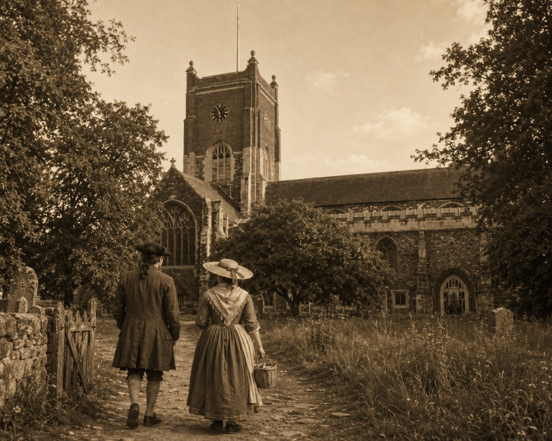
Image ChatGPT
It is the 19th of February. We can see a young couple walking to Kingston on market day but their minds are not on what the traders may have to offer. Their destination is All Saints’ Church, the site of the coronation of several tenth century kings, for this is their wedding day.[6]
What then does history tell us about this couple, who were to become my 5x great grandparents? Nothing further can be found about the groom, Edward Smith. It is likely that he was a Thames waterman, as his son and grandsons were to be. If this is the case, there is an Edward Smith who was bound as a waterman to another Edward Smith in Bermondsey in 1736 and this is probably him.[7] There are Edward Smiths baptised in nearby riverside parishes within a likely timeframe but none in Kingston or Bermondsey[8] and with such a common surname, it is impossible to know which, if any, of the others grew up to marry in Kingston in 1750/1. Although the next generations of the Smith family lived in the hamlet of Ham, we can’t be certain that Edward, or his bride, had been living there. They were married by licence, which may suggest that one or other of them came from another parish.[9]
Edward’s bride is equally elusive but potentially fascinating. She was Anne Selwin.[10] Selwin, often spelt Selwyn, is a very unusual surname, with almost all eighteenth century bearers of the name being found in Gloucestershire or London. It seems almost certain that Anne was somehow connected to the Selwyns of Gloucestershire, who had settled just up the road in West Sheen, as indeed are most other Selwyns but disappointingly, extensive research has failed to place Anne on this, or any other Selwyn, family tree.
The following year, on the 23rd of February, Edward and Anne were back in All Saints, Kingston for the baptism of their son, John.[11] This was a Wednesday, so may once again have been a market day. The next month saw the death of Frederick Prince of Wales, leaving his younger brother, the future George III as heir. With so many members of the court living in the area, the Smiths must have been quickly aware of this national news. In the August of that year, there was a great thunderstorm. If Edward was indeed a waterman, this would have had a serious impact. A whirlwind downriver at Vauxhall lifted two boats out the Thames.[12]
It seems that John was to be Edward and Anne’s only child.[13] This does not help in our quest for Anne’s origins, as childbearing years give an indication of date of birth. With just one child, it is also not possible to look for the reuse of family names. A likely reason for the absence of further children is that, on the 17th of December 1753, less than two years after John’s baptism, an Edward Smith was buried at All Saints.[14] We can’t be certain that this was John’s father but it is a strong possibility. Dealing with the surname Smith, means that we need to be doubly cautious about drawing conclusions.[15]
It looks likely then that young John grew up with his mother. On the 8th of April 1768, when he was sixteen, John was apprenticed as a waterman to John Langley of Richmond.[16] Langley was in his late fifties[17] and had been working on the river for four decades.[18] Many watermen’s apprentices were paupers but it seems unlikely that John was in this position. Normally, apprentices were accompanied by their fathers, as they went into the city to Waterman’s Hall, which was then in the Coldharbour area of Upper Thames Street, to be apprenticed. If his father was indeed dead, his mother, or perhaps a grandfather or uncle may have gone instead.
After two years’ work as an unlicensed apprentice John would have been examined. Those who passed, as he presumably did, served five more years as a licensed apprentice. He would have returned to Waterman’s Hall at the end of the seven years to attend the Court of Watermen and collect his certificate and freedom. From then on, he would be obliged to pay quarterage fees to the company.
The origins of the trade of the waterman are lost in the mists of time. An Act to regulate the fares that they charged was passed as early as 1514. In 1555, the Company of Watermen and Lightermen was founded. Watermen did not have the best of reputations and their apprentices were “notoriously ill-treated”.[19] In 1729, it had been thought necessary to pass an Act of Parliament “For better regulating the Company of Watermen, Lightermen and Wherrymen of the River Thames”.[20] Reasons for the passing of the act were given as follows:
Watermen “have no settled place of abode and are idle and profligate persons --- for the sake of small sums of money --- take great numbers of apprentices, who instead of being brought up to their proper calling --- are suffered to idle about, which brings them to pilfer for their sustenance, and for the generality, they become vagrants, and not seldom come to a fatal end.”[21]
Robert Cottrell wrote as follows in the Foreword of James Legon’s book My Ancestors were Thames Watermen: [Watermen] “have been the most vulgar, rough, foul-mouthed and dishonest band of characters you could ever have the privilege to rub shoulders with.”[22] Despite this, watermen were skilled practitioners and the shooting of London Bridge was considered to be a great feat. The formation of the River Police in 1800 put an end to the traditional piracy of many watermen and lightermen.
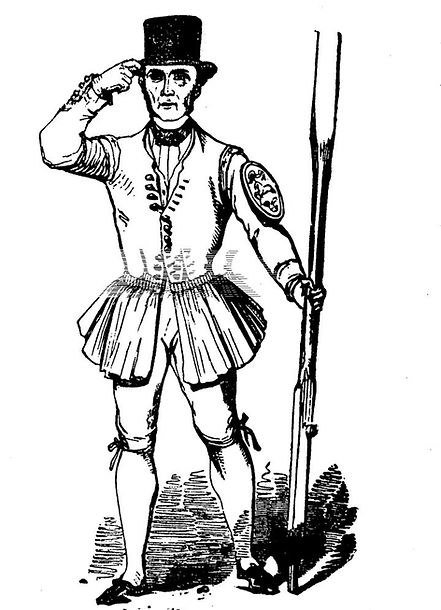
A Thames Waterman in Traditional Costume
Image in the public domain
As a waterman, John would have conveyed passengers across, or up and down, the Thames. The fare from Wapping to Rotherhithe was one penny. Most watermen used six or eight oared wherries, sometimes with an awning and cushions for the comfort of passengers. The lightermen, who belonged to the same company, carried goods. Watermen were particularly vulnerable to the Press Gang, although, in theory, they could not be impressed under the age of eighteen. Some masters had more apprentices than they could use and persuaded the Press Gang to take them. Under these circumstances, the masters were legally entitled to any prize money that the apprentice might win.
John may have worn the traditional red coat and badge of the eighteenth century waterman. Replicas of the coat and badge, known as Doggett’s Coat and Badge[23] are still awarded annually to the winner of a race, between six young waterman, along the four and a half mile stretch of the Thames, between London Bridge and Chelsea.
John was declared free of his trade on the 13th of October 1775.[24] Just six months later, on the 4th of March 1776, his eldest daughter, Ann, was born.[25] No marriage record has been found for John and his wife, Elizabeth but assuming a marriage did take place, there is probably a very short window in which it occurred. It is unlikely that John could have married before the end of his term, unless he had the formal consent of his master.
Who was Elizabeth? We are still hampered by the common surname but all the marriages in the immediate area have been considered and rejected. John‘s signature appears on the marriage records of some of his children, which is useful for comparison purposes.[26] Given that John and Elizabeth’s second daughter was Elizabeth Garnish Smith,[27] it seemed worth investigating Garnish[28] as a possible a maiden name for Elizabeth. There are no likely baptisms but there were eighteenth century Garnish watermen in Rotherhithe[29] and a Jeremiah Garnish, son of Jeremiah, was baptised in Southwark in 1710/11.[30] It is important to note that one of John and Elizabeth’s sons was given the name John Jeremiah;[31] who may have been known as Jeremiah.[32]
The 1770s were not a good time to have qualified as a waterman as, in January 1777, the bridge at Richmond opened for foot passengers and by the September, carts and carriages began crossing, thus diminishing the trade for a waterman working in this area.[33] Ashore too, the landscape was changing, as the creeping fingers of industrialisation reached out towards Ham. Raby’s copper and iron mills were established just a few miles away. In wider news, James Watt had invented his steam engine, America had declared itself independent and Captain Cook had discovered Antarctica.
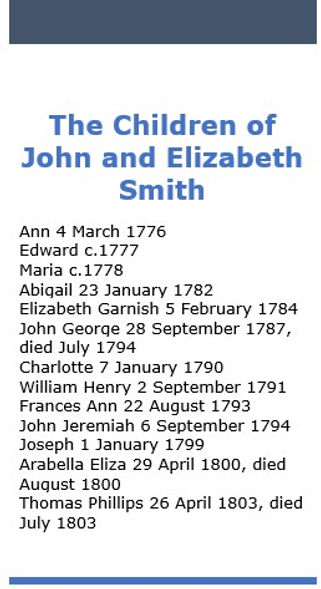
With a frequently found surname, coupled with parents called John and Elizabeth, care is needed when trying to establish which of the fourteen children, baptised in Kingston to parents called John and Elizabeth Smith between 1775 and 1810,[34] belong to my 4x greatgrandparents. Fortunately, the baptism register at this point gives dates of birth. Ruling out impossibly close dates, shows that at least three couples were involved. Several things worked in my favour when trying to untangle these children. Firstly, the fact that John was a waterman, a trade that tended to run in families and several of the boys also became watermen. The fact that the right family lived in Ham, a very small settlement at the time and this is sometimes specified in the records. ‘My’ John and Elizabeth also had a propensity to give their children two christian names at a time when this was unusual. Many of these children grew up to witness each other’s marriages, or were interlinked in some other way. Finally, a will for a John Smith, waterman of Ham,[35] which I initially dismissed as it didn’t mention any of the children that, at that point in my research, I recognised, revealed two additional children and provided further evidence. After years of careful research, it is now my belief that John and Elizabeth had thirteen children.[36]
Interconnections between the Smith Children
We don’t know when John’s mother, Anne, died and it is possible that she remarried but a likely burial at All Saints is that of Anne Smith, widow, on the 10th of July 1787.[37]
As the eighteenth century drew to a close, John and Elizabeth’s sons followed in their father’s footsteps as watermen. The eldest, Edward, was bound to his father as an apprentice on the 11th of April 1793. John was described as being of Petersham,[38] which bordered on Ham, so this did not necessarily represent a move but might have reflected where John was working from. The burials of John George, in 1794 and Arabella Eliza, in 1800, specify that the family was living in Ham.[39] In 1795, John Smith of Ham appears, with five others, on the list of qualified freeholders and copyholders in Ham, designated as a copyholder.[40]
In the 1798 Land Tax return for the hamlet of Ham, a John Smith is listed as owning property lived in by several others. There is a John Smith living in property owned by Richard Bolton, which had a value of 18/-. Either, or both, of these could be a different John Smith. It is fairly certain that the John Smith occupying property owned by Thomas Haverfield, valued at 18/- is our man. Also living in a property owned by Haverfield, this time valued at £1 17/6, is Joseph Seers (sic), who has a role to play in the Smith story. John Smith was also listed as one of the collectors and assessors.[41]
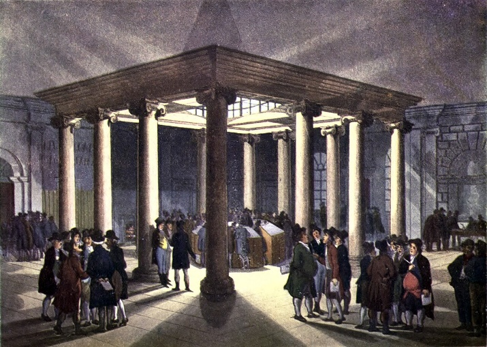
The 1801 freeholders’ list specifies that John was a copyholder and ‘gent’.[42] By 1803, there were ten freeholders and copyholders in Ham, of which Mr John Smith was one. The use of the title ‘Mr’ usually implies some status. Interestingly, in the 1804 return, John is listed as coal merchant.[43] Coal from the Newcastle pits had been shipped down the east coast to London for centuries. By this time, the collier vessels were too large to navigate the upper reaches of the Thames near Kingston and it would have been being brought in by lightermen. Perhaps John had cornered the market for selling the coal to the large houses in the area. The London coal merchants carried out their trade in the Coal Exchange, near Billingsgate Market, where a new building was opened in 1805. Initially a private body, formed to regulate trade in coal in the capital, by 1807, the Coal Exchange was a free market controlled by the City of London Corporation.
The London Coal Exchange 1805
Image in the public domain
John is listed regularly in the freeholder lists until 1813; he was once again listed as a waterman in 1809, 1810 and 1813, although, in 1812, he was listed as a chandler,[44] a seller of candles.[45] To be selling candles and coal, both vital to early nineteenth century London households, was not incongruous. Had his foray into the coal trade been short-lived, perhaps due to the freeing up of the market, or had he always worked as a waterman as well? It is almost certain that these all refer to our John Smith, as there were no other John Smiths who were copyholders in Ham at this time. His son was certainly still referred to as a waterman long after he ceased to ply this trade,[46] so perhaps the appellation was a source of pride that was clung to, even after moving on to work in other fields. It seems, therefore that the generations of Smiths who were shopkeepers or wholesalers goes right back to John of Ham, if not before.
In the January of 1807, John’s wife died and was buried at All Saints church.[47] John was certainly working as a waterman in November of that year, when he took his son, William Henry, as a waterman’s apprentice. At this point, he was said to be ‘of Ham Common’, which was at the south east end of the settlement.[48] On the 22nd of March 1810, at the age of fifteen, John’s third surviving son, 3x great grandfather John Jeremiah, ‘son of John Smith of Ham’, was apprenticed to his father as a waterman. John and his son, would have gone to the new Waterman’s Hall, which had been built at St. Mary at Hill thirty years previously, for the binding.[49] After his father died at the end of 1813, John Jeremiah was later reassigned to Robert Clements of Richmond.[50] Robert was probably only about ten years older than John Jeremiah.[51]
John Smith made a will a couple of weeks before his death, in which he named his two eldest children, Edward and Ann, as well as Ann’s husband, John Bell. Edward, now a bargemaster and John Bell were left all John’s leasehold property, boats, stock and household goods. The remainder and it is hard to know what else there might be, was to be divided between John’s wife Sarah and ‘all my sons and daughters that shall be living at my decease’.[52] It was the mention of Sarah and the lack of named children, particularly John Jeremiah, that made me ignore this will for some time. Sarah, of course, was a second wife. She is almost certainly the Sarah Smith who witnessed the marriage of John’s daughter, Elizabeth Garnish, to Charles Gale in December 1808,[53] giving just a two year window in which her marriage to John might have occurred. Sarah was probably the widowed Sarah Morris, who married John Smith in Teddington on the 3rd of November 1807 and she was more than twenty years John’s junior.[54]
All Saints Kingston
Image Hellodavey1902 Wikimedia Commons
After John’s death, Sarah was to marry Henry Try in Kingston in September 1814.[55] Despite John Smith being apparently comfortably off, Sarah seems not to have benefitted from this. In the 1841 census, her husband, Henry, is working as a labourer and Sarah herself as a launderess.[56] In 1847, Sarah died in the Richmond workhouse of erysipelas, a bacterial infection of the skin usually caused by a cut or bite. In pre-antibiotic days this could lead to sepsis, with the elderly being particularly vulnerable. Although Sarah’s death certificate says she was a widow,[57] there is no death or burial for Henry Try between 1841 and 1847[58] and he seems to disappear from the records.
John Jeremiah was declared free of his trade on the 1st of August 1816[59] and a month later, he married. John Jeremiah was the first of three generations of Smiths to take a bride from the Seear family. He was able to sign his name when he married Charlotte Seear on the 1st of September 1816 at St. John’s Church, Hackney, Middlesex; both were described as being ‘of this parish’. The witnesses were William Seear, almost certainly Charlotte’s father and Mary Lockett.[60] [61]
John Jeremiah does not seem to have practiced the trade of waterman for very long. New bridges,[62] enclosed docks, steam boats[63] and increased road traffic in the early nineteenth century, all led to a decline in the work available for watermen and this may have prompted John Jeremiah to seek a new occupation. Alternatively, it may be that the influence and connections of his wife’s family led to the change.
One of the Smith’s neighbours in Ham was the grocer, Joseph Seear.[64] In August 1815, Joseph wrote a will, in which he left almost all his effects to John Jeremiah’s future wife, Charlotte Seear, who he described as his niece and housekeeper. Three days after writing the will itself, Joseph added a codicil leaving ‘Jeremiah’ Smith, waterman of Richmond’[65] twenty pounds from stock in the four percents from the Bank of England. This will had been proved in the April of 1816, just before John Jeremiah was declared free of his trade.[66] Jane Austen’s Mr Darcy has four percents and these refer to permanent government bonds, or ‘consols’, whereby investors had provided money to offset government borrowing, which was particularly high in the early nineteenth century due to the Napoleonic Wars, in return for indefinite interest payments.
The story of John Jeremiah and Charlotte’s married life continues in Part 2.
[1] Now usually referred to as Ham.
[2] Baker, T H Records of the Seasons: prices of agricultural produce and phenomena observed in the British Isles Simpkin and Marshall (1883).
[3] 1797 List of Freeholders and Copyholders QS3/10A/5 at Surrey Records Centre, accessed via www.ancestry.co.uk.
[4] Bruff, B R The Village London Atlas: the changing face of Greater London 1822-1903 Alderman Press.
[5] Loveridge, Pat A Calendar of Fairs and Markets held in the nineteenth century Romany and Traveller Family History Society (2003). Lysons, Daniel ‘Kingston upon Thames’ in The Environs of London: volume 1, county of Surrey T Cadell and W Davies (1792) pp. 212-256, accessed via British History Online www.british-history.ac.uk/london-environs/vol1/pp212-256.
[6] Marriage register for All Saints, Kingston upon Thames, Surrey, accessed via www.ancestry.co.uk.
[7] This Edward was free of his craft on 25 January 1744. A John Smith had also been bound to an Edward Smith in Bermondsey in 1733.
[8] Index to parish registers of Surrey and Middlesex, accessed via www.findmypast.co.uk.
[9] Unfortunately, the licence and associated documents, which may have provided additional clues, have not survived.
[10] Marriage register for All Saints, Kingston upon Thames, Surrey, accessed via www.ancestry.co.uk.
[11] Baptism register for All Saints, Kingston upon Thames, Surrey, accessed via www.ancestry.co.uk.
[12] Baker, T H Records of the Seasons: prices of agricultural produce and phenomena observed in the British Isles Simpkin and Marshall (1883)
[13] Index to baptism registers of Surrey and Middlesex, accessed via www.findmypast.co.uk.
[14] Burial register for All Saints, Kingston upon Thames, Surrey, accessed via www.ancestry.co.uk.
[15] I am as confident as I can be that the line from John onwards is correct and there are DNA matches to support this. This baptism date, son of Edward and Anne, ties in with John’s stated age at burial. It also fits with John’s binding as a waterman in 1768; note that watermen’s apprentices tend to be slightly older than the traditional fourteen when they begin their apprenticeship, particularly if their fathers were not watermen. Three of John’s sons were apprenticed at sixteen and one at fifteen. John’s eldest two children are called Edward and Ann. These are really much too small to take very seriously but I do have two tiny DNA matches, 8 & 10cM, to the Gloucestershire Selwyns but these could be false matches, or any genetic link could be through another line.
[16] Index to the Company of Watermen and Lightermen of the River Thames’ binding records 1692-1949, accessed via www.findmypast.co.uk.
[17] Baptism register for St. Mary Magdalene, Richmond, Surrey, accessed via www.ancestry.co.uk.
[18] Index to the Company of Watermen and Lightermen of the River Thames’ binding records 1692-1949, accessed via www.findmypast.co.uk.
[19] George, M. Dorothy London Life in the Eighteenth Century Peregrine Books (1966).
[20] George, M. Dorothy London Life in the Eighteenth Century Peregrine Books (1966).
[21] From The Act for better regulating the Company of Watermen, Lightermen and Wherrymen of the River Thames’ (1729), quoted in George, M. Dorothy London Life in the Eighteenth Century Peregrine Books (1966).
[22] Legon, James W My Ancestors were Thames Watermen Society of Genealogists (2008).
[23] In memory of Thomas Doggett, who died in 1721.
[24] Index to the Company of Watermen and Lightermen of the River Thames’ binding records 1692-1949, accessed via www.findmypast.co.uk.
[25] Baptism register for All Saints, Kingston upon Thames, Surrey, accessed via www.ancestry.co.uk. The will of John Smith, proved in 1814 in the Prerogative Court of Canterbury, PROB 11/1557, from the National Archives.
[26] Marriage register for All Saints, Kingston upon Thames, Surrey, accessed via www.ancestry.co.uk.
[27] Baptism register for All Saints, Kingston upon Thames, Surrey, accessed via www.ancestry.co.uk.
[28] This has several spelling variations and can be mis-transcribed as Cornish.
[29] Index to the Company of Watermen and Lightermen of the River Thames’ binding records 1692-1949, accessed via www.findmypast.co.uk.
[30] Baptism register for St. George the Martyr, Southwark, Surrey, accessed via www.ancestry.co.uk. This Jeremiah is a candidate for Elizabeth’s father, or even grandfather.
[31] Baptism register for All Saints, Kingston upon Thames, Surrey, accessed via www.ancestry.co.uk.
[32] Will of Joseph Seear proved in 1816 in the Prerogative Court of Canterbury PROB 11/1577, from the National Archives.
[33] Cloake, John Richmond Past Historical Publications (1991) p.56.
[34] Baptism register for All Saints, Kingston upon Thames, Surrey, accesed via www.ancestry.co.uk.
[35] The will of John Smith, proved in 1814 in the Prerogative Court of Canterbury, PROB 11/1557, from the National Archives.
[36] Baptism, marriage and burial registers for Kingston upon Thames, Surrey, accessed via Ancestry. The will of John Smith, proved in 1814, in the Prerogative Court of Canterbury PROB 11/1557, from the National Archives. Index to the Company of Watermen and Lightermen of the River Thames’ binding records 1692-1949, accessed via www.findmypast.co.uk.
[37] Burial register for All Saints, Kingston upon Thames, Surrey, accessed via www.ancestry.co.uk.
[38] Index to the Company of Watermen and Lightermen of the River Thames’ binding records 1692-1949, accessed via www.findmypast.co.uk.
[39] Burial register of Richmond on Thames, Surrey, accessed via www.ancestry.co.uk.
[40] 1797-1801 List of Freeholders and Copyholders QS3/10A/5 at Surrey Records Centre, accessed via www.ancestry.co.uk.
[41] 1798 Land Tax return for the Hamlet of Ham, Kingston, Surrey, accessed via www.ancestry.co.uk.
[42] 1797-1801 List of Freeholders and Copyholders QS3/10A/5 at Surrey Records Centre, accessed via www.ancestry.co.uk.
[43] 1803-1807 List of Freeholders and Copyholders QS3/10A/6 at Surrey Records Centre, accessed via www.ancestry.co.uk.
[44] 1808-1813 List of Freeholders and Copyholders QS3/10A/7 at Surrey Records Centre, accessed via www.ancestry.co.uk.
[45] He is not listed as a member of the Worshipful Company of Wax Chandlers or of Tallow Chandlers. List of admissions to the Worshipful Company of Wax Chandlers www.waxchandlers.org.uk/wp-content/uploads/2021/01/wax-chandlers-alphabetical-list-of-admissions-1730-to-1950.pdf. London Livery Companies Apprentices and Freemen www.londonroll.org.
[46] Death certificate of John Jeremiah Smith 1874, from the General Register Office.
[47] Burial register for All Saints, Kingston upon Thames, Surrey, accessed via www.ancestry.co.uk.
[48] Index to the Company of Watermen and Lightermen of the River Thames’ binding records 1692-1949, accessed via www.findmypast.co.uk.
[49] Index to the Company of Watermen and Lightermen of the River Thames’ binding records 1692-1949, accessed via www.findmypast.co.uk.
[50] Index to the Company of Watermen and Lightermen of the River Thames’ binding records 1692-1949, accessed via www.findmypast.co.uk. Burial register for All Saints, Kingston upon Thames, Surrey, accessed via www.ancestry.co.uk.
[51] Burial registers of St. Mary Magdalene, Richmond on Thames, Surrey, accessed via www.findmypast.co.uk.
[52] Will of John Smith, proved in 1814 at the Prerogative Court of Canterbury, PROB 11/1557 from the National Archives.
[53] Marriage register of St. Mary and St. Alban’s, Teddington, Middlesex, accessed via www.ancestry.co.uk.
[54] Marriage register of St. Mary and St. Alban’s, Teddington, Middlesex, accessed via www.ancestry.co.uk. Death certificate of Sarah Try 1847, digital image from the General Register Office.
[55] Marriage register for All Saints, Kingston upon Thames, Surrey, accessed via www.ancestry.co.uk.
[56] 1841 census for Goslings Court, Richmond upon Thames, Surrey HO 107 1075 enumeration district 10 folio 18.
[57] Death certificate of Sarah Try 1847, digital image from the General Register Office.
[58] Or Fry. Death indexes of the General Registrar. Index to the burial registers of St. Mary Magdalene, Richmond on Thames, Surrey and surrounding area, accessed via www.findmypast.co.uk.
[59] Index to the Company of Watermen and Lightermen of the River Thames’ binding records 1692-1949, accessed via www.findmypast.co.uk.
[60] This surname is unclear, it could read Caclett or Cockett.
[61] The parish registers of St. John’s, Hackney, Middlesex, held at The London Archives P79/JN/I/52-55.
[62] Waterloo Bridge was being built between 1811 and 1817 and London Bridge was replaced in 1831.
[63] Steamers started working on Thames around 1815.
[64] 1798 Land Tax return for the Hamlet of Ham, Kingston, Surrey, accessed via www.ancestry.co.uk. Although he called himself Seear, he was almost certainly born Joseph Steel and took the surname of his wife Sarah Seear.
[65] There are no Jermiah Smiths who were watermen in Richmond or the surrounding area at this time and John Jeremiah had been bound to Robert Clements of Richmond. Index to the Company of Watermen and Lightermen of the River Thames’ binding records 1692-1949, accessed via www.findmypast.co.uk.
[66] Will of Joseph Seear proved in 1816 in the Prerogative Court of Canterbury PROB 11/1577, at the National Archives. Index to the Company of Watermen and Lightermen of the River Thames’ binding records 1692-1949, accessed via www.findmypast.co.uk.